




A Telluric Topography
By Aurelius Mar. 1996Editor's Note: This overview of the Umbra differs from the one detailed in published books for Mage, Werewolf and Wraith.
What follows is an unavoidably tenuous attempt to render the ineffable Tellurian — essentially the whole corpus of existence and potential existence — as a graphic diagram. Of course no such undertaking will meet with complete (or even substantial) success. The very subject under scrutiny defies such an approach by definition! This does not, however, mean that this task is without merit. On the contrary, while an erstwhile "map" of the entire universe cannot hope to represent everything within the universe, it can provide a guide and metaphysical starting point, making further exploration of the Tellurian, whether spiritually, conceptually or physically, a somewhat less confusing journey. Let the naysayers pooh-pooh this presentation, and for those who desire to better grasp the fundamental relationships between the infinite "places" in reality, read on and enjoy!
To begin, take a piece of paper. For our sake, we shall imagine this to be a three-dimensional space without limit. Everything that can exist, actually or potentially, is contained on this piece of paper. To be more to the point, the paper is the Tellurian.
Now, imagine three tennis ball-sized spheres resting on this piece of paper. Now push them together, and since this is all in your mind anyway, imagine them suddenly merging together so that each intersects its neighbors. Since we cannot easily draw a sphere on a piece of paper, however, we will have to stick with circles, but it is important to remember as we move along that these should be considered whole spheres for purposes of this topographical model.
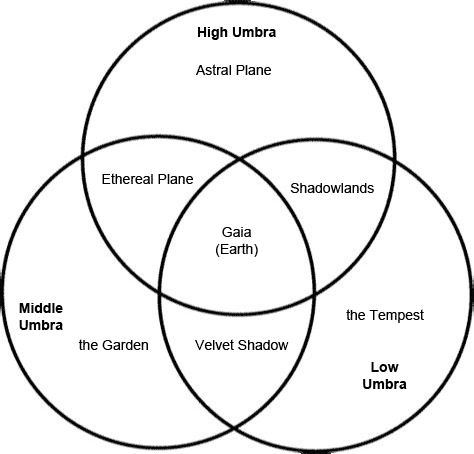
Draw the three circles now, each intersecting the others so that in the end each will have four distinct regions: An area free of the influence (intersection) of its neighbors, an area influenced by one neighboring sphere, an area influenced by the other and finally an area influenced by both neighbors. This last area should, then, be the point of intersection of all three spheres.
Perhaps it isn't so obvious, but these three spheres are the three accepted Umbrae, or aspects of reality. One can also very helpfully imagine them as three spotlights of different colors intersecting. Part of each will be pure, parts will be influenced by another color and in the center all three will merge to create a white light.
So what shall we label the four distinct areas within the spheres? The areas of the spheres which remain pure (do not intersect another sphere) are the three Near Umbrae. Those parts which result from the intersection of two spheres are the Penumbrae. The center area, where all the spheres come together, is Gaia, or Earth.
Okay, where is the Deep Umbra? Well, draw a circle around the three you already have, so that it encompasses them all. The area within this circle, not claimed by the other spheres, is the Deep Umbra.
Go ahead and label the three Umbrae. For simplicity's sake, label the one nearest the top of the page the High Umbra. This is a very colorless name. I therefore suggest writing these additional names, for the following supply much more philosophical, spiritual and emotional flavor: The Astra, The Weaver, Stasis. This sphere is the place of form, structure, pattern, design, permanence and order.
Label the second sphere the Middle Umbra, also supplying the following alternate names: The Spirit World, the Living Umbra, the Wyld and Dynamism. It has many names. This is the place of genesis, growth and rebirth, procreation and change.
The final sphere should be labeled the Low Umbra, along with Dark Umbra, the Underworld (not Shadowlands!), the Wyrm and Entropy. This final sphere is the source of destruction, decay, corruption, extinction, dissolution and finality.
Think of these for a moment not as places, but as the three fundamental cosmic forces that mages so love to discuss: Dynamism, Stasis and Entropy. Better yet, Genesis, Form and Destruction. The Garou like to imagine these universal ingredients as powerful beings. Editor's Note: The werewolves and other changing breeds see these forces as all existing in the Middle Umbra. Most of them know nothing about the High or Low Umbrae. However they are seen, they are unchanging at their core. In fact, one should imagine that there is a single point at the center of each of these spheres, a precise location where the ultimate purity of the concept of each sphere can be said to exist. We will return to this later.
Remember the spotlight analogy? At one time the three Umbrae (or cosmic forces) were all superimposed upon each other perfectly making just one Umbra (God?) with three aspects. Something happened and this single Umbra began to divide into three separate spheres. This separation has continued ever since and, theoretically, if it doesn't cease, the world will disappear forever. Why? Because Gaia is really only the result (a shadow!) of the overlap of the three Umbrae (actually, the Dreaming is very important too, but we'll save that for the moment), and should they completely separate, the dynamic causing the Earth will be no more!
Getting back to the spheres, look at the one titled High Umbra. Label the part that doesn't overlap another sphere the Astral Plane. The unmixed part in the Middle Umbra, label the Garden. The unmixed part in the Low Umbra, label the Tempest. Here the Umbrae are relatively pure (as discussed above), but not entirely. Don't think of the borders of the spheres as made of iron, but rather as composed of fog — really fuzzy, but present. This means within these Near Umbrae the influence of the other spheres will vary depending on how "far" one is from the border of another sphere. Once you cross a border, however, you have left the Near Umbra for a Penumbra. More on this below.
Here can be found the myriad Realms so frequently spoken of and visited. In the Garden one finds the supposed 13 Realms with some, like the Abyss, closer to the border of the Underworld (Low Umbra) and others, like the Aetherial Realm, closer to the border of the High Umbra. The same goes for the Astral Plane, where its Realms will be influenced to varying degrees by their proximity to the other Umbrae and ditto for the Tempest. Horizon Realms in the Astral Plane, for example, can be drawn on your map as little circles resting just inside the outer curve of the Astral Plane, while Stygia and the Dark Kingdoms of the Underworld can be drawn as small circles floating inside the Tempest.
Somewhere within the very center of each sphere (as mentioned above) exists a place of cosmic purity, where that Umbra is completely uninfluenced by its neighbors. In the Underworld this place/point is called the Labyrinth, where Oblivion itself can be found. In the Spirit World this place is called the Summer Country, where nothing can die and genesis is the only force. In the Astra there is a similar place where only static structure exists (I call this Metropolis).
Now, let's move along quickly to the Penumbrae, whose borders are two Umbrae and Gaia itself. These places are literally shadows of Earth, each one effectively being a reflection of the world as we know it with one of its three composite cosmic aspects filtered out. They should be labeled as follows.
Where the Astral Plane and the Garden overlap, label this the Ethereal Plane. Where the Garden and the Tempest overlap, label this the Velvet Shadow. Where the Tempest and the Astral Plane meet, call this the Shadowlands.
The Shadowlands are literally Earth without the influence of Dynamism (at least to any effective degree). This is a reflection of Earth's death. Here there is form and pattern, to be sure, but genesis, growth, creation and continuance don't exist. It is the place where Stasis and Entropy meet, where structure and its destruction are everything. Here the High and Low Umbrae meet to create a place where form marches unceasingly towards oblivion, quite literally. The border between the Shadowlands and Gaia? The Shroud, of course (or more generically, a Gauntlet). Here is where one arrives when one attuned to death steps sideways.
This view that the Penumbrae are actually located at the juncture of two different Umbrae and not simply part of one, is my own and not the published view of White Wolf Games. However, after much contemplation and insight, I believe that this view is not only more conceptually and graphically correct, but in the end makes actual play easier.
The Velvet Shadow then, is Earth without the force of Stasis. It is Earth's spiritual, living reflection. Here exists genesis, growth and life alongside destruction, decay and corruption. Though it would seem form surely exists, the actual cosmic aspect of stasis does not. Form, one should remember, is actually being given to this place by our own preconceptions. Without some form to what we encounter, we, as beings composed of all three cosmic forces, cannot begin to truly comprehend what we encounter. The barrier between this place and Earth is called the Velvet Curtain. This is where Garou and shamanistic mages go when they step sideways.
Finally we have the Ethereal Plane. This is Earth's intellectual and conceptual reflection. Here the force of Entropy holds no sway. Genesis, creation and dynamic evolution come together with forms and lasting structures to create a place of undying ideas, thoughts, concepts and archetypes. Without Entropy none of these things can truly die, though they can surely be diminished in the dynamic struggle for supremacy. Things are created and given form, but cannot ever really be destroyed. The barrier between this place and Earth is quite simply called the Gauntlet. This is where most mages go once they step sideways.
Once one crosses over from Gaia to one of these Penumbrae, however, one must be careful about looking back at Earth. Unless one is experienced enough to know the difference, it is possible to accidentally "get light in one's eye," so to speak, and see an illusion instead of the real Earth. This "place" is called the Mirror Zone and it can lure many an inexperienced umbral traveler. Be careful!
Without going into too much detail about the specifics of each of the three Umbrae (as they are covered elsewhere in great depth), it should be noted that these three "spheres" or aspects of all possible existence are not the only ingredients necessary for existential manifestation, despite the hubris-laden beliefs of many umbral travelers. Alone, these three cosmic forces cannot result in the complete picture of reality as we perceive it. Sure, one can have dynamic creation, after which form is taken, until finally entropy dissolves the creation back into the nothingness from whence it came. However, this can not accomplish everything. There is one final fourth cosmic force that is significantly different, yet fundamentally a peer of the other three: Imagination. Yes, imagination. Inspiration, originality. The Muse! The Dreaming!
Look at your piece of paper again. Now imagine the three intersecting circles as three-dimensional spheres in front of you, melded into one another. Imagine them as the three basic colors: red, blue and yellow. What about shading? What makes them light and dark? Simple: inspiration, imagination. Glamour.
Imagine a fourth sphere, shimmering with pearly light, nestled above and center of the other three. Picture this sphere, the Dreaming, sinking down a bit until it too begins to intersect that middle area, a place now bisected into complete colorlessness and complete color. Day and night. The night is the world without the influence of this sphere, while the day is the world with it. This final intersection of the fourth sphere is geometrically complicated to imagine on an effectively two-dimensional map, but with a little imagination it can be done.
Where The Dreaming impinges upon Earth we have the waking world (or uninspired world) and the dreaming world (or inspired world). This world of dreams that essentially exists here on Earth is called the Dreamlands and is entered through the normal process of sleep. Just outside of the sleeping Earth you can find the Dreaming Penumbra, a chimerical reflection of the Earth's dreams, called the Near Dreaming (not to be confused with the Near Umbrae). The barrier separating this place from the Dreamlands can be labeled the Mists (so an ordinary person could enter the Near Dreaming if in their dreams they could penetrate the Mists). The Near Dreaming is the effective counterpart to the three Penumbrae and touches and intersects each of these areas. Further out, geometrically equivalent to the Near Umbrae of the Astral Plane, the Garden and the Tempest, is the Far Dreaming, a place of Dream Realms where even the fey tread lightly and watch their backs.
What of the Deep Umbra and the places said to be there like Malfeas, Paradox Realms, etc.? What about the Deep Dreaming, said to be indescribable and very dangerous, within which Arcadia can be found?
Forget all you know. The various Deep Umbra and the Deep Dreaming are the same. Sort of. On your paper, draw a large circle around the Umbrae and the Dreaming, encompassing them all. Now, everything within this giant circle, but not already within the Umbrae or the Dreaming is the Deep. Now, when one is closer to one of the Umbrae or the Dreaming this Deep will seem to be more influenced by the concept embodied therein, but it is all really the same giant bowl of soup! Scary?
What lies beyond this final shell? What does the rest of the piece of paper represent, the part beyond the Deep Umbra/Dreaming? This is the Null Zone; the theoretical backstage of all existence. Here the most fundamental axioms necessary for existence are found. While the rest of the Tellurian is purely subjective, this place is purely objective and no subjective will, no matter how strong, can change anything.
Obviously, much has been said in a quick and perhaps rambling manner. Suffice to say, there is so much more to say. I only hope that I was able to provide the basic tools necessary for arriving at a usable topographical representation of the Tellurian and how it "all comes together". I think this is pretty close. Then again, I could be wrong.