



Notes and Essays
Editor's Note: The content on this page was never a part of Ander's Mage Page. The linked page is no longer online so it has been recreated here for your reading pleasure.
A Note on Translation and Transliteration
Taken from The Wisdom of Ancient Egypt by Joseph Kaster, without permission but in nothing more or less than the spirit of scholarship.
"Much sympathy is to be extended to the many interested persons who, in their various readings in Egyptian history, religion, and related subjects have been utterly confused by the wide disparity in the transliteration of Egyptian words and proper nouns. When a reader has encountered such variant forms as Ra and Re, Amenemhat and Amenemmes, Tahutimes, Thothmes, Thutmose, Tuthmosis and Thutmosis, Amenhotep and Amenophis, Akhenaten, Akhenaton, and Ikhnaton, he is justifiably entitled to his confusion. A few words on the reasons for these different renderings and on the nature of the written language of ancient Egypt as we have it are in order.
"All forms of Egyptian, with the exclusion of Coptic, were written with the consonants only. There are no vowels as such in the signs used in the writing. Egyptian shares this orthographic peculiarity with other Semitic languages such as Hebrew and Arabic. We can pronounce Hebrew and Arabic with more or less accuracy because during the Middle Ages a series of little marks were devised to designate the different vowels and were written over or under the consonants with which they were to be pronounced. This was not done with ancient Egyptian, as Coptic, the last stage of the language, was written with an adaptation of the Greek alphabet, in which the vowels are part of the alphabet itself. It is important to remember, however, that Coptic differs from classical Egyptian as much as, say, current vernacular English differs from Old English or even Anglo-Saxon, and it seems only logical that it is as incorrect to pronounce classical Egyptian according to derived words in Coptic as it would be to pronounce the language of King Alfred like modern English. It has become the fashion, however, among some modern scholars to try to work back the pronunciation ala Coptic, but to this writer it seems rather futile, for the reason just given.
"It was long ago decided among Egyptologists that since we do not know the vowels, the only thing to do in order to pronounce the words is to insert a short 'e' (the vowel of greatest frequency in the European languages) between the consonants-- a most logical and sober procedure. Thus the word for 'good' or 'beautiful', which is spelled in Egyptian with the consonants n,f, and r, we transliterate NFR and we pronounce 'nefer'. For all we know, it may have been pronounced nofar, nifer, nufar, or even nefer. The fact that in Coptic the word has become noufe (pronounced noo-feh) has given rise to such renderings of proper nouns of which the word is a part as Nofretiti.
"We have a number of royal names rendered into Greek in various Greek writings dating from the late period. The Greeks had quite a cavalier attitude to all foreign names and absolutely "murdered" them. Thus the name of the Egyptian deity who was a scribe of the gods and a patron of learning, which reads, in Egyptian, something like Djehwty, the Greeks rendered variously as Thoth, Thouth, Thout and in theophoric (god-bearing) names introduced further corruption plus the ornament of a Greek ending, with the result that in the name of a king such as Djhwty-ms, "Born of the God Djehwty," we get such specimens of wild misrenderings as Tethmosis and Thmosis. Again it has become fashionable among some modern scholars to use the Greek renderings of Egyptian names in their translations, which accounts for Ammenemes, Sesostris, Tuthmosis, and so on. To this writer, at least, it seems not only affected, but barbarous and recalls the old-fashioned 18th and 19th century custom of using the Roman names of the gods when translating from the Greek: Zeus was "Englished" as Jupiter, Athena as Minerva, and so forth."
For the reasons given above, within this site I will tend to favor the names of the Egyptian gods in the form of transliterated heiroglyphs as opposed to the more common Greek or Anglicized renderings.
The Egyptian Calendar
Keeping track of hours, days, and months was of the utmost importance to the Egyptians, as there were many sacred occasions that had to be observed in order that the spiritual bond with the gods and with the dead could be maintained. The task was complex and crucial enough to require the complete attention of specially trained priests whose duty it was to mark the passage of time.
The new year started with the inundation of the Nile, presaged by the first appearance of the star Sothis (Sirius). Now the Egyptian calendar followed the lunar model, with 12 months of 30 days each divided into three seasons. The difference between the solar and lunar year was compensated for by the presence of the five Epagomenal Days, the sacred days commemorating the births of Asar, Heru the Elder, Suti, Ast, and Nebt-Het. The actual year is 365.25 days long, however; our calendar takes this into consideration, giving us an extra day every four years (the 'leap year'), added to the month of February. We shall instead include an additional Epagomenal Day every four years to keep the calendar accurate, and devote it to a celebration of Nuit and Geb.
The following converts our modern (Gregorian) calendar to that of the Egyptians, for the sake of maintaining the traditional sacred occasions.
| Egyptian Season | Egyptian Month | Gregorian Date | Notable Occasions |
|---|---|---|---|
|
Akhet Season of the Inundation |
Djewhty | June 21 to July 20 |
Wepet: Egyptian "New Year's Day", summer solstice, June 21. Sothis (Sirius) rises.
Night of the Tear (at start of inundation) |
| Paopi | July 21 to Aug 19 | ||
| Athyr | Aug 20 to Sept 18 | ||
| Khoiak | Sept 19 to Oct 20 |
Autumnal Equinox, Sept 21 Festival of Sokaris (at end of inundation) |
|
|
Proyet Season of Planting |
Tybi | Oct 21 to Nov 19 | Festival of Asar's Beauty |
| Mekhir | Nov 20 to Dec 19 | ||
| Pnamenotu | Dec 20 to Jan 18 | Lamentations of Ast and Nebt-Het, Winter Solstice, Dec 21. | |
| Pharmuthi | Jan 19 to Feb 17 | ||
|
Shemu Season of the Harvest |
Pakhons | Feb 18 to Mar 19 (18)* | Festival of the Djed Pillar (Feb 18) Festival of the Coming Forth of Minu (at harvest) |
| Paoni | Mar 20 (19) to April 18 (17) | Vernal Equinox, Mar 21 Beautiful Feast of the Valley |
|
| Epep | April 19 (18) to May 18 (17) | ||
| Mesore | May 19 (18) to June 15 (14) |
* Dates in parentheses refer to leap years.
| Epagamonal Days | |
|---|---|
| Gregorian Date | Day Sacred To... |
| June 15 (leap year only) |
Nuit and Geb |
| June 16 | Asar |
| June 17 | Heru the Elder |
| June 18 | Suti |
| June 19 | Ast |
| June 20 | Nebt-Het |
Festivals
The Egyptians observed the nights of the new moon and the full moon as monthly holidays, commemorating the symbolic death (new) and rebirth (full) of Asar. In addition, there were many annual festivals celebrating various mythical and historical personages and events. Generally speaking, each temple had a calendar of its own religious holidays, but owing to the theocratic tendencies of the Egyptian cities, some of these holidays spread in popularity to become more widely celebrated.
Some of the more well-known festivals, feasts, and holidays are listed below.
- Wepet, or Wepet-Renpet
- New Year's Day; coincided with first appearance of Sothis (Sirius) at approximately the time of the Northern Hemisphere's Summer Solstice (June 21).
- Night of the Tear
- Celebrated the start of the inundation of the Nile. Ast's tears of mourning over the death of Asar are said to cause the Nile to flood, which in turn brings life to Egypt.
- Festival of Sokaris
- Takes place at the end of the inundation of the Nile.
- Celebration of Asar's Beauty
- Celebrated at the start of Proyet, the season of planting.
- Lamentations of Ast and Nebt-Het
- Coincides roughly with our Winter Solstice, December 21st, and represents the mourning over the newly-reassembled corpse of Asar and the posthumous conception of his son, Heru.
- Festival of the Djed Pillar
- First day of Shemu. Festivities included the raising of the Djed Pillar (sacred to Asar and symbolic of the rule of morality and justice) and a mock battle between the forces of good and evil. Represents the ascension of Asar to the throne of the underworld.
- Festival of the Coming Forth of Minu
- Celebrated at harvest time. Minu was a fertility god, depicted as a man with an erect penis wearing a plumed crown with a streamer.
- Beautiful Feast of the Valley
- In the month of Paoni. A celebration in honor of Amun, which included a public procession of a statue of the god. Feasts were held to honor the dead.
- Festival of Amentet
- Part of the festival involved men commemorating their sons or fathers.
- Feast of Hathor
- Celebrated at Dendera, the center of Hathor's cult. Reinactment of the story of Hathor destruction of mankind at Ra's bequest; mankind was spared when Hathor was tricked into believing that red beer that had been spilled in the fields was the blood of the last men.
- Fall of the Nile
- Festival of the Two Bulls
- Festival of the Tail
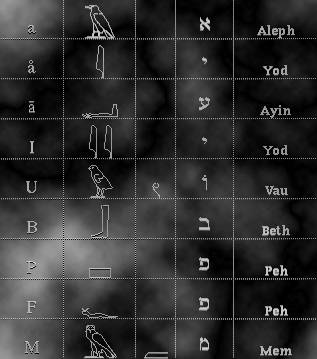
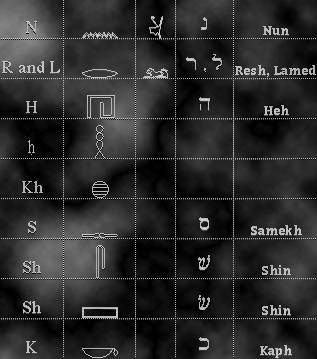
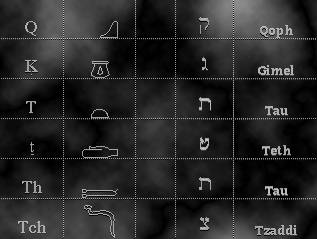
Egyptian Hieroglyphs and their Hebrew Equivalents
These charts will be undoubtedly useful to those of a Qabalistic bent. I used the work of Dr. E.A.W. Budge as the starting point and made a few corrections as I saw fit in light of my own research.
The Peril and Necessity of Astral Travel
As Nuit herself is the massless bridge between all worlds, the intelligence that fills the void between stars, any travel to worlds beyond our own is necessarily through her body. In the movement of the stars, the endless network of connecting tunnels or conduits are traced. These are the very paths that the dead aspire to wander; the paths undertaken by those few who are blessed or cursed with true dreaming; the roads that the likes of Ast and Asar travelled in order to emerge in our world as gods.
How can we aspire to travel through the vastness of the sky, to visit the distant worlds and unimaginable territories beyond the night? The very laws of physics-- Maat as the Egyptians might call them, the 'way that things are and must be'-- seem to hold us down, trapped at the very bottom of an invisible gravity well. We are confined between the kingdom of Yesterday (Asar) and Tomorrow (Heru). We are locked in the present. This benign tyranny may be justified, as it holds the masses in the safe shadow of the two great fathers. But there are those among us who cannot accept the gift of their protection, who yearn to free themselves and face the abyss on its own terms, for a single chance at ascension.
Travel through Nuit's gates is essential for this ascension. The very symbol of divinity and eternal life, the ankh, is nothing more than the depiction of a sandal strap; here is proof enough that mastery of distances, through unbounded travel, is requisite for attainment of the divine state.
The problems of escaping the gravity well are numerous and varied. First, there is gravity itself to contend with. This is the embrace of the Father of the Gods, Geb, pulling us to him. As is shown in an early story of the trials of Heru, however, Geb's will (heart) is weakest when he sleeps, and his mind very slow to rouse. This suggests that night-time is most propitious to astral travel-- a point that will only be reinforced by further reading.
Beyond Geb's languid but tenacious grasp there are more threats to the traveller. The most subtle of these is the obstacle of absence-- the absence of the air that we require to sustain our life. This is a problem not without a solution. Ast herself may be persuaded to aid in astral travel. For she it is who, with her great wings, provides those in her care with the cool and "sustaining" wind.
Of the further dangers of the great starry abyss, little is known. Many of those who have attained or aspired to ascension have not returned, and of those who have, much of what they attempt to communicate to us is so garbled or easily misconstrued that nothing comes of it save yet another malformed religion (Buddhism, Christianity, Thelema...). Even in Qabalistic terms, the final path to Kether is that of the Fool; and the would-be Ipsissimus who travels it becomes all but incomprehensible. Whether this is due to a loss of sanity or to the attainment of so-called supersanity, it is impossible to say. Perhaps their wits burn up on re-entry.
There are many lessons to be learned through the study of the pseudo-Boddhisattvas (which some would translate as 'idiot savants', but not I of course) and their avatars (the so-called prophets), even if those lessons serve only as examples of how NOT to attain enlightenment. What would best serve us would be to return to the stories of how the gods of our world immigrated to be among us, leaving their native lands behind, that they might serve us as kings.
Manuals of so-called astral travel abound in our time, telling tales of sophisticated dream-work and the powerful implications of the human imagination. While these techniques may be fine for honing the creative potential of the mind, or for training the symbolic reflexes, most of them have very little to do with any sort of exploration of the world beyond the birdcage of the cranium. A distinction must be made: dreaming and imagining allow the mind to travel between 'worlds'; science may provide the escape velocity for removing ourselves from the physicality of the gravity well; but to travel the inky Veil of Nuit is to set the very soul on a course through the potentialities of the unknown universe.
These cautions and suggestions now lead us to the matter of exactly how one might approach travel through the Veil of Nuit.
In the "Tep Zepi", or First Times, Nuit and Geb were together, wife and husband, in a sexual embrace. Shu, god of the wind that comes just before dawn, separated their bodies, and that of Nuit made the arch of the sky above. This allowed the space between the two to fill with the air that would sustain life. Now in the mind of the Egyptian absolutely everything was a cycle, from the annual inundation of the Nile, to the rising of the sun-- even as far as the creation of the world. Each day when the sun set, the safety of the created world order was threatened by the powers of darkness. And each morning, the world was created anew. The god that is the wind that comes before dawn, separates the bodies of Nuit, the sky, and Geb, the earth. It becomes clear, then, that by night, Nuit and Geb return to each other, to their primeval embrace. With an understanding of the goddess herself, one has but to climb the cold, dark sinews of her body as it reclines against that of her husband while the Eye of God passes through the underworld. The earth is content; asleep, and in the arms of his eternal lover. One has but to secure his permission, to barely rouse him from his sleep, to be granted leave of the power of gravitation. Then one has to learn to see the body of Nuit as she lies, and to enter her, that the spaces between stars might become as short as the spaces between footsteps. If one is endeared to Ast, then she will provide the sustaining air; to Nephthys, then the abundance of the invisible armies of the night will guide and protect.
The ones who have secured such endearments between themselves and the daughters of Nuit need no more guidance than this.