




Spirits and Beings of the Egyptian Umbra
By Anders SandbergDjinn
The Djinn are the elemental spirits of the desert, ranging from mischievous dust-devils to roaring and deadly storms. They represent furious urges unfettered by thinking, serving none but are somewhat linked to Set and other destructive forces. Usually they just try to make life hard for people. Across the Arabian world there are many different descriptions of Djinni and other forms seem to exist on the seas (where they can appear as ships with burning lamps), in the mountains or on islands. In the deserts of the material world they appear as small tornadoes, snakes, pillars of sandy air or as roaring storms, depending on power and mood.
Charms: Create wind, Updraft, Disorient
A Djinn can create winds, ranging from small gusts to huge storms, carry away people or objects and change landmarks so that travelers get lost.
The Watchers
The Watchers are often confused with the Djinn but are really a separate order of being (some mages call them the true Djinn and the lesser Djinn are seen as mere elementals or subservient spirits). Unlike the Djinn they cannot manifest physically even with the help of magick and they usually appear as Arabian people dressed in opulent clothes and speaking in a cultured manner (but unable to utter the name of Allah). They are quite proficient in magick and can shapeshift into animals or storms (which is most likely the reason they are confused with the lesser djinn, who often serve the Watchers grudgingly). Beside their shapeshifting, they are often extremely skilled in Matter, able to create the most magnificent treasures or buildings instantly. According to one story they helped king Solomon build his temple.
They live just on the other side of the Gauntlet, perpetually watching the affairs of humans and fey (they get along fabulously with the Eshu) and learning their secrets. According to the myth they were created before mankind by Allah but lacked souls, something they deeply envy the humans. According to the Al-Anam sura of the Quran, it is forbidden for the Watchers and humans to interact with each other. While the elder watchers (if elder has any meaning among immortals) respect the Will of Allah and remain faithful (according to the Al-Djinn sura even the Watchers can reach salvation) there are some Watchers who instead seek to escape their existence and gladly deal with humans or other beings. They can create marvellous things, teach profound secrets and generally aid people but their works are often subtly cursed with ill luck even when they mean no harm.
Some Watchers have attempted, after much eloquence, to trade some of their power for the soul of a person. In the few cases it has occurred, the Watcher became fully human (and with ordinary human capabilities and frailties), while the human became an immaterial Watcher — powerful but forever cut off from mankind. On the other hand, some Arabian mages have learned how to summon and imprison Watchers into talismans such as lamps, flasks or rings, forcing them to do their owner's bidding.
Charms: as Master mages, usually very skilled in Matter. They can shapeshift into whatever they desire.
The Stone Snake
This wise and powerful being protects certain places and objects from intruders. It appears like a huge snake, at least sixteen meters long, covered with lapis lazuli scales, eyes of emeralds, teeth of diamond and powdered rubies as blood. It wears a one meter beard like an Egyptian god. It is likely closely related to the Watchers or perhaps a Watcher itself.
Normally it resides on the Island of the Ka, an enchanted island in the umbral ocean. The island is a veritable garden of eden filled with ripe figs, grapes, vegetables, cucumbers and an abundance of fish and wild fowl. According to the myth there were originally 75 similar snakes but all but one were destroyed by a falling star. Today it seldom leaves the island but some old spells still bind it to intervene to protect.
Charm: Airt sense, Armor, Healing, Materialize, Mind speech, Master level Matter and Life.
Spirit Crocodiles
These beings live in or near the Nile in the Umbra. They prey on other beings, dragging them beneath the surface of the umbral Nile into the watery depths. While they do not necessarily serve Nun, they are beings of death, voraciousness and cunning. Sometimes they venture up from the Nile into the Cairo Umbra to prowl the alleyways, preying on the unfortunates no one misses.
Charms: armor, flood, tracking
The Camels of Pestilence
These disgusting creatures are the manifestations of disease in the city. Their forms are based on the ancient tradition of leading a camel through all parts of a city haunted by pestilence (thus infusing it with disease) and finally strangling it on holy ground, hopefully killing the disease with it. It seems some camels have returned to hunt the umbra, appearing as walking camel carcasses with bloody ropes tied round their necks. Where they appear, disease appears and they gain sustenance from the weakening of sick people.
Charms: Cause Disease
By using this charm, the Camel can induce a contagious disease in a victim. Causing a cold or bowel unrest requires 2 points of Power, while incurable diseases such as AIDS requires 20 points of Power. The victim can resist the disease with their Stamina, difficulty depending on the disease. The Camel gains one point of power for each health level lost due to disease in their vicinity.
Guardian Angels
These beings are invoked by imams to protect the faithful from the dangers of the Djinn and other umbral beings or sent by Allah. They walk around their protégé in the Umbra, shielding from attack and corruption.
Charms vary but common angelic charms include: Armor, Healing, Cleanse the blight, Influence (advice or conscience), Spirit Static.
The Sphinx
The Sphinx is the most powerful guardian spirit in the world, protecting the three central pyramids from magickal attacks. In the Umbra its real self is visible, a huge lion-man hybrid filled with inscrutable watchfulness and power. Its face is no longer entirely human and looks more like a lion than in the physical world.
It is unknown how old it is but according to some hermetic scholars it is much older than the pyramids, possibly dating back to the ancient times when the gods walked the earth and the desert flowered. According to one myth, it remained behind when the age of gods ended in the Aeon of Leo to guard the land against some unknown threat. According to another theory, it is awaiting the time when the gods will return. The Sphinx isn't telling.
While most of the time it just watches the Nile, anyone approaching the pyramids with a destructive intent in the Umbra is attacked with ferocious force. It seldom speaks but when it does it usually speaks in riddles and mysteries, often mentioning the constellations of the stars and the Nile.
Tarot Card: the Wheel of Fortune
Dwellers of the Tuat
The Tuat is filled with wretched beings, some of them once humans, some its own. They all crave life, pleasure, light, anything to escape the dreadful world they inhabit. Most of them are just minor entities, not much more than an irritating whine or a word repeating itself endlessly, but there are also once-humans now warped by millennia of despair into howling corpse-things and monstrous beasts longing for the taste of soul-flesh. They are trapped in the Tuat unless someone leads them out of it somehow. Sensitive mages may sense their soundless whispers in the remote desert or from the depth of refuse pits. Some mages have learned to use these creatures to do their dirty work and Set is especially fond of using them as his own expendable servants.
Charms: almost anything
Ach Spirit
The ach-iker, the perfected ones, seem to be representations of powerful people who have died in spiritual perfection. Normally they just move along their own inscrutable purposes but mages who have broken the Law of Maat or suffer from paradox can attract their attention. They move against him, causing bad luck, accidents and possibly even death. This may be the real story behind the "mummy's curse" and a good reason mages should tread lightly in the old temples. The ach-iker in the physical world are invisible other than as a powerful, aloof presence, while in the Umbra they appear as silent, tall, shining people dressed in ancient Egyptian finery.
Charms: Curse/Bless (as the Entropy sphere).
The Osirians
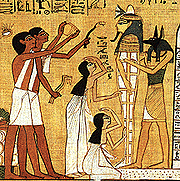
The Osirians are the noble dead, the dead who have been correctly embalmed and consecrated. Their seven souls are bound together by magick, making it possible for them to travel across the worlds (including the Umbras) and, if they still have a mummy or a properly consecrated statue, even the material world (although paradox is a big deterrent). Today most osirians exist in the Kingdom of Reeds, far away from the dealings of mortals but rare occurrences can bring them forth from their habitations. Unfortunately they are vulnerable to desecration: if their bodies are destroyed they cannot manifest physically, if their graves are desecrated they may loose strength, if their name is erased they will cease to exist. Time, vandals, puppets of Stygia, archaeologists and unbelief have largely exiled the osirians from the physical world.
An Osirian consists of several souls joined together in a complex way (se Aurelius excellent essay The Constituent Parts of Identity for details):
- Ren
- The True Name. This aspect is the abstract, nearly indestructible identity of the Osirian. As long as there is a single inscription anywhere with that name, or a being who knows it, the Osirian will still exist or have existed. This is why it is so important to pass the Hall of Two Truths, so that Thoth may enter the name into his scroll. Deliberately erasing inscribed names is a way of weakening and potentially defeating the dead — most cannot stand it.
- Sekhem
- The Quintessence making up the individual. To remain in existence an Osirian needs a source of Quintessence, either by being buried in a sacred place, by being given regular sacrifices or by being admitted to the Kingdom of Reeds, which acts as a source of Quintessence (in turn empowered by the pyramids).
- Khu
- The Avatar. The Khu is not bound by the ritual and can be reborn by following Ra on his eternal cycle of rebirths. However, the Khu of an Osirian will aid it as long as it exists, even if the Khu currently is the avatar of someone else.
- Ab
- The heart, the Essence of the Avatar. During mummification all the organs except the heart are removed. The heart acts as the nexus between the body and spiritual aspects and ties them together. It was magickally strengthened by placing a heart scarab amulet in the bindings. If this is removed the link to the body is broken and the can never manifest physically.
- Ba
- The psyche, the conscious mind of the person. Together with the Ka it could travel through the Umbras but once in the Reed Kingdom the Ba could remain there alone, leaving the Ka to guard the tomb.
- Khaibit
- The Shadow, the dark part of the mind that wants to bring oblivion or dissolution. This aspect must be weakened or defeated sufficiently to make the last trip through the Hall of two Truths. If it is too strong the heart will be heavier than the feather of truth and the person will become immediately engulfed by the Devourer.
- Ka
- The ephemeral form, the double of the body in the Umbra. The rituals aim at strengthening it enough to become able to withstand the harsh tests of the afterlife and then guard the grave.
- Khat
- The physical body. As long as the mummy was sufficiently intact, the could inhabit it. It was also possible to inhabit statues of oneself, as long as they had been consecrated by the Ritual of the Opening of the Mouth.
- Söhu
- The entropic double, the corpus of existence in the netherworld. This is the aspect needed to exist in the Tuat.
It is worth noting that many of these souls can exist independently. A full osirian could have his Ka guarding his grave, his Ba in the Land of Reeds and his Khu on the bark of the sun. To perform a magickal act the Khu and Ka must be united and to perform it consciously the Ba is also needed. To manifest physically they need a body receptacle too.
It is often erroneously believed that osirians are created solely by the ritual of embalming. This is only a part of the process, albeit crucial for them to be able to return to the world into a proper body. The other parts are the necessary will and beliefs to remain a single entity and not to disperse into nothingness (or to unite with the solar light) and the arduous journey of purification that has to be undertaken to gain recognition at the court of Osiris. If the latter is not done, the will never find his way to the sanctuary of the Reed Kingdom and will be forever exposed to the dangers and denizens of the Tuat. Full osirians can instantly reform in safety of the kingdom if attacked. In order to complete the journey many dangers and tests must be overcome and knowledge of the Book of the Dead is crucial.
Throughout history the secret of osirification has been sought by many but powerful groups have hid it. Today it is likely only the Priestesses of Isis and possibly the Watchers know it. Several mages are known to have undergone reconstructions of the ritual but the eventual success is unknown.