



The Alchemists
By Anders SandbergThe alchemists are a sub-group somewhere between Order of Hermes and the Sons of Ether. While they use the terminology and symbols of the Order, they share the solitary attitude and the interest in the sphere of matter with the Sons.
History and Politics
The origin of alchemy is lost in time. Alchemists sometimes claim that the Art was created in Egypt, by the god Thoth (sometimes identified with the Greek Hermes). During the Alexandran period (4th to 7th century AD) alchemy flourished. Alchemy developed, influenced by the Gnostics and by hermetic groups in the Mediterranean. Many alchemists argue that the great truths of the Art were first discovered by Hermes Trismegistus (The thrice blessed Hermes), a mage somewhere in the first century. But it was not until the Middle Ages that alchemy became the Art known today.
The alchemists have a history of ignoring the politics of the Order of Hermes. Like the Cabalists, they gained considerable influence after the fall of the false order. Disappointed hermetics joined the alchemists, and they became one of the most influential sub-groups of the Order during the Renaissance. During this time the alchemists were the bridge between the Order of Hermes and the Sons of Ether. They could perform their arts almost in plain sight as physicians and learned men. Their ranks included several famous mages like Artephius, Geber, Paracelsus, Agrippa and count Saint-Germain. Some of these may still be around.
The alchemists unwittingly created the ideas the Technocracy used to create their chemistry and medicine, thereby slowly destroying the power base for them as physicians and pharmaceuticists. In fact, some alchemists joined the Technocracy in order to help them create a true system of the science of matter. Newton may have been one of them. According to malign rumours among alchemists, the young Newton (hardly more than an apprentice) had created an intelligence increasing elixir which he used that fateful summer when he "discovered" the laws of mechanics and gravity. Afterwards he joined the Void Engineers (founded by Copernicus himself). But unfortunately his reliance on his secret elixir made him prematurely senile, a just punishment according to the Alchemists.
The alchemists became known as goldmakers and frauds as the technomancers grip on chemistry, medicine and physics increased. But the Alchemists turned out to be a bit more resistant than the technomancers thought and managed to survive. Today they still use their magick, using health food and alternative medicine as camouflage for their own medicine. Alchemical societies exist in many larger cities.
The Alchemists and the Sons of Ether are very close. Some alchemists have begun to use the methods of the Sons, trying electricity and the technical methods. Sons of Ether have been deeply influenced by the alchemists in their models of how the ether behaves (the Alchemists claim to have developed the theory in the early Middle Ages, something the Sons hotly dispute). In fact, it is hard to tell where the Alchemists end and the Sons begin. The most notable difference is terminology. Alchemists prefer the hermetic obtuse symbolism, using Kabbalah, astrology and the Greek gods in their magick, while the Sons prefer their own quasi-scientific jargon.
Like the Sons, alchemists pursue their pet projects with single-minded determination, often not stopping until they succeed or fail miserably. If an alchemist has an idea, he will not hesitate to test it. This has led to some brilliant results, like Paracelsus Homunculus, but also to the early death of many alchemists.
Alchemists do not engage in the Ascension War directly. They instead try to subtly spread their ideas and sabotage the technomantic science. Their most successful method has been the spread of distrust against technomancer medicine and the upsurge in alternative medicine. They have several times succeeding in turning technomancer pawns into their unwitting helpers or even convert them completely. Pons and Fleichmans cold fusion may have been a joint Sons of Ether-Alchemist project. Another thing the Alchemists struggle against is fluoridation of drinking water. The Alchemists suspect that the fluorides are used for mind-control or even nastier things. They have managed to spread much bad press about fluoridation. Still, the Alchemists are hardly any match for the technomancers, but manage to survive due to their secrecy.
Alchemic Doctrine
The most important idea of alchemy is that everything is evolving. Everything will slowly become something more advanced given time. A child will grow up to become an adult. Stones will evolve into ore, which will evolve into metals or gems. Lead will evolve into gold given enough time. This evolution can be sped up by the mage. This is the essential idea of the Great Work, the Alchemists' Ascension: that the mage, by his art, can encourage the evolution of everything into even higher forms.
There are three kingdoms: mineral, plant and animal. These correspond with the three alchemical elements (not to be confused with the classical four elements) Salt, Sulphur and Mercury. Each kingdom will slowly evolve into the next. A stone will become ore, which becomes metal, which becomes a simple plant, which will become more advanced plants, which will become a simple animal, which evolves into higher animals, which will become a man, who will evolve into higher, unknown levels. So far, the universe has not evolved very far and the process takes a very long time, especially at the lower levels. Almost no plants derived from metals have appeared yet and very few animals derived from plants.
The alchemists try to understand the evolution of matter and life by taking substances apart into their components, refining these and then merging them together again. This process will not only influence the substance but also the mage. The whole process of transmuting lead into gold represents the transformation of a sleeper into a mage, or a mage into an ascendee. By mixing the proper substances the mage will change himself. By changing himself, matter will change.
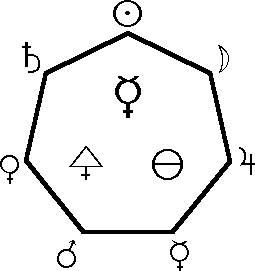
The mineral kingdom is ruled by the seven kings: lead, tin, iron, copper, mercury, silver and gold. Since the mineral kingdom is the lowest and most fundamental kingdom, these metals are very important. The other mineral substances like salt, sulphur, saltpetre, earth, gems and water are used in the alchemical processes ruled by the metals. The alchemist slowly learns to transmute base matter into finer matter, lead into tin, tin into iron, iron into copper and so on. This is a preparation of the Great Work.
The Great Work consists of finding the Red Stone, also known as the Philosophers Stone or the Elixir. This (not only a physical substance but also a spiritual one) will transmute everything. Lead into Gold. Man into Superman. It is the alchemical Ascension, when everything will evolve into the highest possible state and the universe becomes truly complete. The alchemists want to hasten this evolution by finding the Red Stone.
As in the Order of Hermes, symbolism is everywhere and everything is connected to everything else. Each organ of a patient's body is ruled by a planet and a zodiacal sign which in turn correspond to an element and a metal. To cure a heart disease the alchemist would use elixirs containing gold and fire. Every plant and animal has subtle signs telling the experienced alchemists their uses and symbolism.
Philosophy
"When handled properly, the base material will turn into The Black Stone. The Black Stone will be transmuted into the Yellow Stone. The Yellow Stone will become The White Stone. And the pure White Stone will become The Red Stone, known as the Philosophers Stone to the lay-people.
Do you understand? No, I didn't think so. The process is not just a chemical process. It is also a spiritual process inside the mage. It is also a spiritual evolution of the world. When we finally have achieved the creation of the Red Stone, it will transform the whole world. That is why we are tirelessly working in our laboratories, to bring about the great day.
How far have we come? Even if I wanted to tell you, you wouldn't understand anything. Misunderstandings can be even more dangerous than no understanding at all. Alchemy is the secret art and not to be discussed openly."
Organisation
A loose network of individuals and alchemical societies. Most alchemists are solitary, with perhaps an apprentice or some helpers. Sometimes, especially in larger cities, they form alchemical societies where they meet to discuss the art.
Meetings
Seldom. The alchemical societies sometimes meet on astrologically important days to perform experiments together. Many alchemists schedule their work after the stars, planning so that it will be initiated and end on correct days (this may lower target numbers).
Initiation
Several years of apprenticeship is required. During this period the apprentice is often treated more as a janitor than a future mage. Slowly the apprentice learns the art from scraps of information, the rantings of the master and his own intuition. Some alchemists claim that the hard apprenticeship is necessary to impart the practical knowledge and the burning desire to succeed a true alchemist needs.
Chantry
Alchemists often stay at the chantries of other hermetics but seldom found their own. In Paris there exists an alchemical society founded by count Saint-Germain himself (he is rumoured to still be the leader), which has a secret chantry somewhere.
Acolytes
Amateur chemists, health food freaks, gullible rich.
Sphere
Matter. Alchemists often study Life almost as intensely as matter. Most alchemists start with Matter, then begin to study Life when Matter is mastered. Other common spheres are Prime, Forces and Mind. Time is very seldom used due to the severe restrictions (see below).
Foci
Alchemists use chemistry (not the technomancer perversion, of course, even if some alchemists are quite adept chemists too) as focus for all their magick. To perform a magickal effect they must perform an alchemical reaction of some kind. The most used are melting, crystallising, distilling or burning. For example, a Ball of Abysmal Flame would require the alchemist to throw a mixture of gold and iron dust into a fire, which would explode. In healing, the mage would distil some blood from the patient with some copper salts and give the resulting fluid as medicine.
One of the good things about this method is that the alchemist does not have to do alchemical reactions "in the field" if he has already done them in the lab and taken the end products with him. The only requirement is that the mage is present for the final use of the magick. Many alchemists use Prime or other spheres to create "one shot-talismans", potions or substances that will perform their function even without the mage nearby.
- Correspondence
- Tin or sometimes sea salt. The metal of Jupiter.
- Entropy
- Lead. The metal of Saturn. Cold, heavy and inert.
- Forces
- Iron. The lodestone feels the forces of nature and steel gives mankind the powers to transform it. Magnetic iron is very powerful.
- Life
- Copper. The daughter of Gold and Silver. Often organic materials are used instead, especially for creating life, healing or transforming. Alchemists are strong proponents of the Law of Sympathy and prefer to use fluids or body parts from the subject of the magick (this will also give a decrease in difficulty).
- Matter
- Heat. Fire represents the purifying force, which destroys impurities and transmutes base material into finer. The heat of the sun nourishes the plants and allows them to evolve from seeds into fully grown plants. The heat of a body nourishes the egg and evolves it into an animal or a man. Generally, the lower substances involved, the greater heat is required. The most advanced operations require extremely slow and careful heating.
- Mind
- Mercury. Quick, brilliant and flowing. Symbolic of the planet and the god. Son of Gold and Silver. If taken in the wrong way, it will destroy the mind of the user (poor Newton!).
- Spirit
- Silver. The metal of the moon. The wife of Gold. Lapis Infernalis, silver nitrate, is often used.
- Prime
- Gold. The sun-king of the metals, which rules the others. Often used as dust or in solution in aqua regia. Sometimes diamonds or other fine gems are used instead (the more expensive, the more powerful).
- Time
- Time. Alchemists using Time will perform an alchemical process taking a certain time and preferably on an astrologically correct day. The time used depends on how powerful is the effect. A simple Time 1 effect is just a minute of silent thought (many alchemists use Time 1 to time their experiments), while a powerful Time 5 rote would take several months of time. The rote "Zen and the art of panhandling" would, if an alchemist performed it, perhaps consist of keeping gold and iron melted in a crucible for seven months and then pouring the mixture into water, and drinking the hot water on a Sunday. Many alchemists prefer to allow their processes to take a long time, just to be sure.
Concepts
Chemist, Herbal healer, Scientist
Quote
"Do you know what INRI really means? Of course I know what the Church says, "Iesu Nazarinus Rex Iudorem", but that is just the exoteric meaning. The esoteric meaning of INRI is "Igni Natura Renovatur Integra": "All of nature is renewed by fire". Do you understand? Don't you see now, why you must keep the fire constantly burning under the crucible? Don't you see how this relates to the Great Work, to the Ascension?"
Stereotypes
- Akashic Brotherhood
- Meditation is nice but hardly any magick. And martial arts can be useful too but they are also hardly magick.
- Celestial Chorus
- What are they trying to do? The Great Work cannot be done by merely singing hymns and praising the light. They simply prefer to bask in the knowledge of the Higher but not to achieve it.
- Cult of Ecstasy
- Can't say much about their magick but several of them are good customers of mine. You would be surprised how much tass they pay for some of my elixirs.
- Dreamspeakers
- I thought my apprentice didn't have a clue, until I saw these.
- Euthanatos
- Survival of the fittest? They believe in their own perverted evolution but true evolution towards the heights cannot be forced by death and violence.
- Hollow Ones
- These mages are the first faltering steps towards the new race which will evolve out of humanity. Too bad most of them lack training and control. That is something that someone should do something about.
- Necromancers
- That's funny, each time I search for some tome they suddenly appear, spy a bit, and disappear. They seem to think that I know something. Or they know something. Creepy.
- Order of Hermes
- Without our brethren we would never have come this far. Without their magnificent work in cataloguing, studying and formulating the principles of magick, no alchemy would be possible.
- Rosicrucians
- What have they done?! They have turned the Art into a pastime for bored rich! The millennia old secrets of nature is told to almost anybody!
- Sons of Ether
- Brilliant fellow researchers. They are a bit short-sighted but that's not a problem for us. Their ideas will one day help furthering the Great Work.
- Verbena
- These witches have some very good ideas, and some very bad ideas. Their blood magick is brilliant and we have to admit they far ahead of us in that area. But they have completely misunderstood the meaning of evolution! They try to turn humanity back to the animals we once were! We must stop them from trying to turn the clock backwards!
- Virtual Adepts
- Huh? What are they doing? "Transcending the human condition through technology"!? They are completely insane. How can anybody believe their parody of true evolution?
Rotes
Light the Elemental Fire (Forces 2)
The alchemist uses a little lamp of iron filled with consecrated oil for this rote. By pouring some sulphur into the oil, the oil ignites into a pure blue-white flame. This fire is quite normal except its color and is used to ignite other fires in the lab (sometimes alchemists use fire ignited by lightning instead). The longer the fire is kept alive, the more pure it will become. Some alchemists have fires which have been kept alive for centuries, passing from master to student countless times. These fires are almost talismans in themselves and extremely pure. Their exact powers are not very well understood but they are generally sought after.
Transmutation (Matter 4)
The most well known rote of all alchemist rotes. The mage heats a piece of metal for a long time, carefully meditating on the true secrets of transmutation. When the metal cools, it has become pure gold.
Growing Gold (Matter 2 Prime 2)
Another gold-creating rote, this one invented by Nicolas Flanel (the alchemists need much gold to finance their expensive magick and for use in Prime). Since everything is alive to some extent, metallic gold can be coaxed to grow given the right nutrients. The mage places a small amount of gold in a crucible and adds another metal, preferably mercury. The crucible is heated and the result is that the gold absorbs nourishment from the metal and the heat and increases.
Elixir of the Sun (Mind 2 Prime 2)
The mage mixes together mercury and gold into an amalgam. This amalgam is left in the sun during the day and heated during the night. After several days, the amalgam is pulverised and added to wine. This wine will, if drunk, make the user appear much more powerful than he really is. The user will, at least for a while, make people around him very impressed and awed.
Love Potion (Mind 2 Prime 2)
While most alchemists think this rote is a bit silly, they can't deny the demand for the potion. Besides, it's a classic almost all apprentices want to learn. A typical love potion will work by making the drinker both susceptible to seduction and more amorous. The alchemist mixes mercury salts, rose water, expensive spices and a small amount of gold (preferably from a wedding ring or something like that). The mixture is carefully heated and then distilled. The distillate is added to food or drink.
Each success will lower the target number by one for all attempts at seduction or other amorous skills for the victim. It will also make the victim see every possible partner as having more in appearance and charisma than they really do. Each success will increase the apparent charisma and appearance by one.
Elixir of Longevity (Life 3)
Another classic rote, invented in countless variations. The alchemist distils some of his blood, adds expensive spices and salts and drinks the final product. This elixir will halt the aging of the mage for a time, but not rejuvenate him (there are lots of competing rejuvenation elixirs around).
Reanimation (Life 3 Prime 2)
The alchemist burns a dead (or alive) plant or animal. The hot ashes are mixed with exotic chemicals and salts. Finally, gold solved in aqua regia is added and the mixture is allowed to crystallise. By performing the necessary incantation and slowly heating the resulting salts, the mage will restore the being to life. If the mage succeeds well enough, the being will be completely normal in all aspects. A less successful experiment would give a being which would die after a while, turning into salts again. And really bad results create "nothing but ye liveliest Awfullness". Some alchemists experiment with turning people to dust, and trying to raise them again. If anyone has succeeded, they haven't told anyone.
Homunculus (Life 3 Spirit 2 Prime 2 Time 3)
Paracelsus developed this famous rote. The mage takes some of his bodily fluids, adds silver and gold salts, and pour the result into a vessel. The vessel is kept at a constant body temperature for nine months (in the Middle Ages, a heap of dung was used). After the time a small, fully grown man has developed in the vessel. This homunculus is intelligent, has a will of its own and will grow at the normal rate after it has left the vessel. Some mages keep their homunculus inside it for safe keeping, feeding them of their own blood. Homunculi are often used as advisors, familiars or servants. However, if the mage treats them badly, they may rise up against him.
Famous Alchemists: Count de Saint-Germain
Count de Saint-Germain, alias count Surmont, count Welldone, count Soltikoff, count Tzarogy, marquise di Aymar, prince Rakoczi or Ahasverus, is one of the most powerful alchemists around. Known as an adventurer, gentleman and scholar. His exact age is unknown, as is his nationality. According to rumours he learned alchemy in Egypt and is more than 2000 years old.
What is known is that he was in France in 1748, where he moved in the highest aristocracy. He was favoured by Ludvig XV and became envoy to the Netherlands. Something went wrong and he fled to London in 1760. In 1762 he was in Russia and then in Belgium where he met Casanova. In 1776 he was at the court of Frederick II of Prussia where he entertained the King with chemical experiments. In 1784 he officially dies in Schleswig where he was building a paint factory for the count of Hessen. Count de Saint-Germain continues to appear and disappear around the world, a bit more discretely after the technological age. For example, in 1930 he was seen on the deck of an Atlantic liner.
The witty count never said anything direct about his true age or whether he really could create gold. He was a fantastic storyteller, always telling stories about historical events almost like he had been there. Sometimes he made a mistake, like when he told his friends about the life of Henry IV "...and then the king turned around and smiled at me... I mean, he smiled at duke X." The count never said that he was really immortal, just avoided the question. Sometimes he said "I just look younger than I am."
Count de Saint-Germain is probably master of Matter and Life and has a high arcane. He is regarded by mages as one of the greatest alchemists and also as a true gentleman. The count seemed to spread the belief in alchemy during the period before the French Revolution but afterwards he has gone underground, only appearing from time to time to keep the public interested and irritate the technomancers. If rumours are true, he is the leader of an alchemical society in Paris for the moment, or he is travelling the world spreading the art.
Other Information
The Solificati by Andrew E. Larsen. A different take on alchemy, in my humble opinion much better than mine.
Alchemy Home Page LINK BROKEN
The Secret Book by Arthepius. An authentic description of how to create the Philosophers Stone. LINK BROKEN
Paracelsus, Five Hundred Years: Three American Exhibits.
See also the section about alchemy in the Arcanum Sourcebook, which describes unenlightened alchemy.
Archive of alchemy articles.